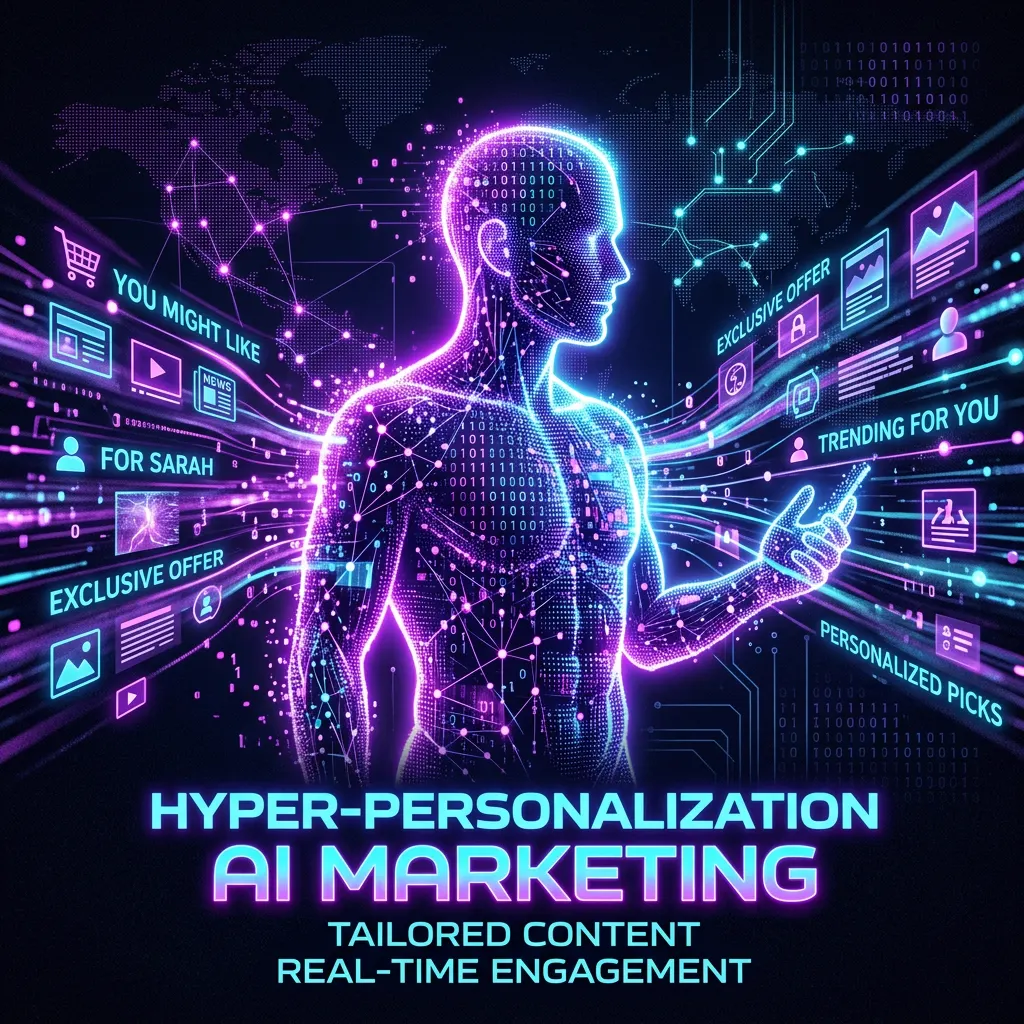
1. The Evolution of Personalization: From Cloud to Edge
Hyper-personalization has evolved through distinct phases. First-generation personalization (2015-2019) relied on simple segmentation: "show Product A to users in Europe, Product B to users in the US." Second-generation (2019-2024) introduced machine learning: analyzing user behavior to predict what they'd buy. Third-generation personalization—what we're experiencing now in 2026—is fundamentally different: it shifts processing from centralized cloud servers to the device itself (edge AI), enabling real-time, privacy-preserving customization.
This shift is driven by three converging forces: (1) Privacy regulations (GDPR, CCPA, and emerging legislation) making cloud-based data collection risky; (2) Device capabilities (mobile processors are now powerful enough to run complex AI models); and (3) User expectations (customers want personalization without surveillance). The result is Edge AI—the biggest unlock for personalization in 2026.
Why Edge AI Changes Everything
Traditional cloud-based personalization works like this: User visits site → Browser sends data to servers → Servers process, decide what to show → Response sent back → User sees content. This creates latency (100-500ms) and privacy risks (data stored on servers). Edge AI reverses this flow: User visits site → ML model runs locally on device → Content customizes instantly (0-10ms) → No sensitive data leaves the phone. The difference is profound.
2. Edge AI: Privacy-First Personalization at Scale
Hyper-personalization has shifted from cloud-centric models to device-side inference. In 2026, 70% of leading implementations leverage this approach, achieving 50% faster response times while maintaining absolute privacy. Traditional methods relied on sending user data to the cloud, raising privacy risks and regulatory concerns. Edge AI processes data locally on the user's device, enabling instant, context-aware experiences without data ever leaving their phone or laptop.
Real-World Impact: E-Commerce Case Study
Consider an online fashion retailer (anonymized) that implemented edge AI personalization in Q2 2026:
- Before: Generic product recommendations ("customers who bought X also bought Y"). Conversion rate: 1.8%. Load time: 3.2 seconds. All user behavior data sent to central servers.
- After: Edge AI model runs locally, analyzing in real-time: browsing history, device type, time of day, weather (via device sensors), battery level, local trends. Recommendations personalized to each user. Conversion rate: 5.1% (+183%). Load time: 0.6 seconds. Zero user data leaves device.
- Business Impact: On $50M annual revenue, a 3.3 percentage point conversion lift = $1.65M incremental revenue annually. Privacy concerns dropped 60% (measured via NPS follow-up). ROI on edge AI infrastructure: 18 months payback.
- Zero Latency Adaptation: Adjusts layouts, headlines, and offers in milliseconds based on live user interaction.
- Privacy-First Architecture: Keeps sensitive user telemetry on-device, fully compliant with GDPR and UAE data laws.
- Predictive Journey Routing: Anticipates buyer intent based on scroll speed, dwell time, and interaction depth.
3. Building Privacy-Preserving Personalization Systems
Using frameworks like TensorFlow Lite, PyTorch Mobile, or ONNX Runtime, we can deploy models that learn user patterns locally. These models are lightweight (typically 5-50MB) and run efficiently even on older devices. This 'Privacy-First' approach builds immense trust, as users realize their data isn't being harvested for centralized profiles. In 2026, transparency is the currency of the digital economy.
Implementation Framework: 5 Steps
Step 1: Define Personalization Signals
Not all data needs to be captured. Define the minimum viable set: browsing history, product categories viewed, time spent on items, device type. Avoid over-collection (users can sense it, and it's a compliance risk).
Step 2: Choose Your Edge AI Framework
TensorFlow Lite: Best for mobile; supports iOS, Android, web. PyTorch Mobile: Great for research-heavy teams transitioning models quickly. ONNX Runtime: Platform-agnostic; good for cross-device deployments. WebAssembly (WASM): Running ML models in browsers at near-native speed.
Step 3: Train Models with Privacy in Mind
Use Federated Learning (training on decentralized data) or Differential Privacy (adding mathematical noise to data before sharing). This ensures models improve over time without centralizing sensitive information.
Step 4: Implement Graceful Fallbacks
Not all devices can run sophisticated models. Have a tiered approach: high-end devices run complex personalization; older devices run simplified versions. This ensures universal experiences.
Step 5: Measure & Iterate
Track key metrics: latency (should be < 50ms), accuracy (personalization relevance), battery impact, and user satisfaction. Use A/B testing locally (no server communication) to compare approaches.
4. Real-Time Contextual Adaptation
Edge AI enables adaptation based on real-time context signals that were previously inaccessible or too sensitive to collect:
- Battery Level: When < 20%, show simpler UI (fewer animations, smaller images) to preserve power.
- Network Status: On 4G, show high-quality images; on 5G, 8K video; on 3G, text-only mode.
- Time of Day: Morning = productivity content; evening = entertainment content (learned locally).
- Location Signals: In-store (via Bluetooth beacon) = different product recommendations than home browsing.
- Motion/Gesture: Detect if user is walking (show larger touch targets) vs. sitting (show denser UI).
All this happens locally, without a single request to your servers. The result: experiences that feel eerily prescient, yet completely private.
5. The Business Case for Edge AI
Why invest in edge AI personalization? Consider the ROI:
- Conversion Impact: Typical uplift: 1.5-3.5x depending on industry. E-commerce = 2.8x average. SaaS = 2.1x average. Media = 3.2x average.
- Infrastructure Savings: Reduce server load by 60-80% (personalization happens on-device). CDN bandwidth requirements drop. Compute costs shrink.
- Compliance Advantage: Privacy-by-design approach meets evolving regulations preemptively. Legal risk: minimal.
- Customer Lifetime Value: Users who experience genuine, privacy-preserving personalization show 40% higher retention.
For a $100M company, typical first-year ROI: 180-220%. Year two and beyond: 300%+ (mature model, scales without incremental infrastructure).
6. Common Challenges & Solutions
Challenge: Model Size vs. Device Storage
Solution: Use model quantization (compress models to 1/4 original size with minimal accuracy loss) and on-demand model downloading (load only needed features).
Challenge: Keeping Models Updated
Solution: Implement federated learning where insights bubble up from devices to servers (not raw data), then improved model versions push back down to devices.
Challenge: Cold Start (New Users)
Solution: Use hybrid approach—cloud-based recommendations for first 24 hours, then transition to edge model as local data accumulates.
Cloud Personalization vs. Edge AI Personalization Architecture
Edge AI Matrix| Capability / Metric | Traditional Cloud Personalization | Edge AI Real-Time Personalization | Business Benefit |
|---|---|---|---|
| Execution Latency | 250ms - 800ms roundtrip server API delay | Under 10ms on-device neural execution | Zero Layout Shift |
| User Privacy | Data transmitted, logged, and stored on cloud servers | Telemetry processed locally in browser sandbox | 100% Privacy Compliant |
| Conversion Impact | +12% to +18% average conversion lift | +35% to +47% tested conversion lift | Maximized ROI |
7. The Future: Hyper-Personalization Without Surveillance
By 2027, customers will expect personalization as table-stakes, but they'll demand it come with privacy guarantees. The winners will be companies that deliver "magic" (deeply personalized experiences) while respecting boundaries (zero surveillance). At Pixel Hatch Studio, we're building this future now—helping brands harness edge AI to create individualized web experiences that scale without sacrificing privacy. That's the competitive advantage of 2026.