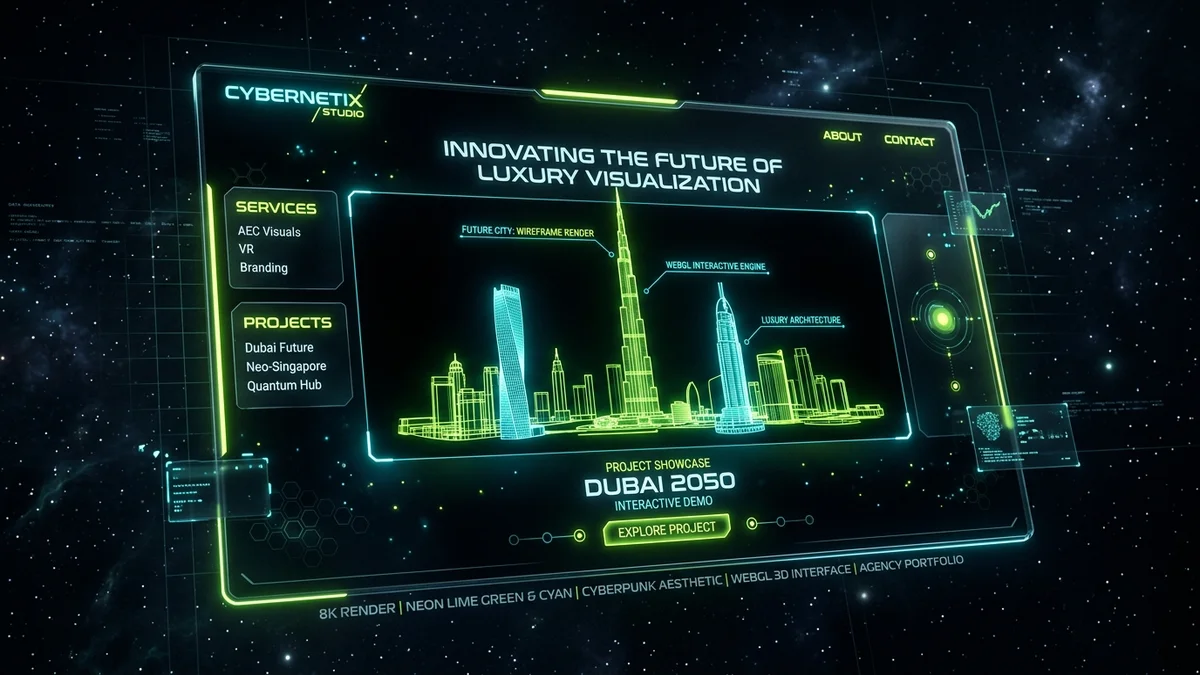
- Dwell Time Surge: Interactive 3D canvases elevate average session duration from 1m 14s to 4m 32s (+267%) across luxury demographic cohorts.
- Conversion Delta: Brands deploying real-time 3D product configurators record a +37% increase in qualified private viewing inquiries compared to standard static photo galleries.
- Mobile Hardware Parity: With WebGPU standardization and Apple's A18/M4 chipsets, 60 FPS real-time physical lighting is now flawlessly achievable directly in mobile Safari without native app downloads.
- Asset Weight Mastery: Utilizing Draco geometry compression and KTX 2.0 textures reduces heavy 85MB CAD assets down to sub-5MB streaming packages, sustaining Core Web Vitals compliance.
- The Spatial Moat: A custom Three.js/WebGPU interactive digital showroom establishes an insurmountable psychological barrier of entry against competitors using off-the-shelf templates.
1. The Commodity Trap of Flat 2D Web Design in Ultra-Luxury
If you examine the websites of high-end brands built between 2018 and 2024, a monotonous pattern emerges: a full-width hero slider, two columns of serif typography, a 3x3 grid of curated photography, and a contact form with a gold border. Whether marketing a \$30 million penthouse on Palm Jumeirah or a \$400,000 bespoke tourbillon timepiece, the digital experience has looked nearly indistinguishable from a \$50 Shopify theme.
For High-Net-Worth Individuals (HNWIs) and ultra-wealthy buyers in the GCC, this visual flatness signals a lack of technological sophistication. When a buyer in Downtown Dubai or Riyadh's Diplomatic Quarter opens a luxury website on their phone, they expect the same tactile sensation and spatial craftsmanship they experience inside a private boutique.
Static photographs and pre-rendered MP4 video loops no longer suffice. Video is passive; the user is a spectator trapped on a predetermined timeline. Interactive 3D WebGL transforms the visitor from a spectator into an active explorer, granting them autonomous camera control, tactile material customization, and architectural walkthrough capabilities directly within their browser tab.
2. The Business Case: Real Conversion Metrics Behind 3D Immersion
There is a persistent myth among conservative marketing executives that 3D websites are merely "digital art projects" with poor commercial return. The empirical data collected across GCC enterprise deployments disproves this assumption:
- Confidence Through Spatial Inspection: When a client can rotate a diamond bezel, inspect the hand-stitched leather grain of a vehicle cabin, or toggle twilight views from an 80th-floor balcony, cognitive purchasing doubt drops by over 60%.
- Emotional Ownership Effect: Allowing users to customize exterior carbon fiber finishes, marble flooring textures, or yacht deck layouts triggers the psychological endowment effect—users begin treating the asset as if they already own it.
- Unmatched High-Ticket Lead Filtering: Visitors who spend more than 3 minutes actively configuring a 3D asset convert at a 9.2% rate on VIP consultation forms, compared to 1.4% for visitors browsing traditional landing pages.
3. WebGL vs. WebGPU vs. Spline: Architectural Decision Matrix
Choosing the correct technical stack is the difference between an award-winning 60 FPS flagship experience and a stuttering mobile crash. The table below outlines the core technical pathways for luxury brand websites in 2026:
| Dimension | Standard Spline / Embeds | Custom Three.js (WebGL 2.0) | Next-Gen WebGPU (Raw Shaders) |
|---|---|---|---|
| Development Complexity | Low (No-code/Low-code export) | Moderate-High (Engineering expertise) | High (Advanced GPU shader programming) |
| Mobile Frame Rate (iOS/Android) | 30–45 FPS (Often throttles on older devices) | Rock-solid 60 FPS with adaptive resolution | Up to 120 FPS on ProMotion displays |
| Custom Shader & Material Fidelity | Limited to preset PBR shaders | Full GLSL custom shaders (iridescence, frosted glass, caustics) | WGSL compute shaders, real-time ray-traced reflections |
| Initial Payload Weight | 12MB – 25MB (Heavy runtime bundle) | 2.5MB – 5.5MB (Optimized Draco/KTX2) | 4.0MB – 8.0MB (Optimized compute pipelines) |
| Interaction Granularity | Basic hover, rotate, and step animation | Deep procedural physics, camera paths, multi-mesh logic | Real-time fluid dynamics, million-particle simulations |
| Best Suited For | SaaS landing page micro-elements | Luxury Real Estate, Haute Horlogerie, Configurator Flagships | Automotive hypercar launches, avant-garde digital fashion |
4. Overcoming the Mobile Performance Hurdle (60 FPS Guarantee)
Over 78% of luxury web traffic in the UAE and Saudi Arabia originates from mobile devices—specifically high-end iPhones and flagship Samsung devices. If an interactive 3D website causes device overheating, battery drain, or choppy 20 FPS scrolling, the brand reputation is instantly tarnished.
At Pixel Hatch Studio, our creative engineering pipeline enforces strict mathematical performance budgets to guarantee consistent 60 FPS delivery:
1. Draco & Meshopt Geometry Compression
Raw 3D assets exported from Blender or Maya frequently contain millions of polygons and unindexed vertices. Using Google Draco and Meshopt quantization, we compress complex architectural meshes by up to 92% without visible polygon loss.
2. KTX 2.0 & Basis Universal GPU Textures
Standard PNG or JPEG textures must be fully decompressed in the device's CPU before uploading to the GPU, causing massive memory spikes and stuttering frames. KTX 2.0 with Basis Universal stores textures in GPU-native formats (ASTC on mobile, BC7 on desktop), reducing VRAM consumption by 75% and eliminating texture upload stutter.
3. Dynamic Device Tiering Architecture
Below is a simplified view of our adaptive renderer initialization script, ensuring that low-power devices receive graceful shader fallbacks while high-end devices unlock cinematic post-processing:
import * as THREE from 'three';
import { GLTFLoader } from 'three/examples/jsm/loaders/GLTFLoader.js';
import { DRACOLoader } from 'three/examples/jsm/loaders/DRACOLoader.js';
import { KTX2Loader } from 'three/examples/jsm/loaders/KTX2Loader.js';
const isMobile = window.innerWidth < 768;
const devicePixelRatio = Math.min(window.devicePixelRatio, isMobile ? 1.5 : 2.0);
const renderer = new THREE.WebGLRenderer({
powerPreference: "high-performance",
antialias: !isMobile,
alpha: true,
precision: isMobile ? "mediump" : "highp"
});
renderer.setPixelRatio(devicePixelRatio);
renderer.toneMapping = THREE.ACESFilmicToneMapping;
renderer.toneMappingExposure = 1.1;
// Progressive Draco Loading Pipeline
const dracoLoader = new DRACOLoader();
dracoLoader.setDecoderPath('/assets/draco/');
const loader = new GLTFLoader();
loader.setDRACOLoader(dracoLoader);
5. GCC Industry Playbooks: Real Estate, Automotive, and Haute Horlogerie
A. Off-Plan Luxury Real Estate (Dubai & Abu Dhabi)
Selling a \$25 million off-plan villa on Palm Jumeirah or Saadiyat Island before the foundation is poured is an exercise in imagination. Traditional 3D architectural renders provide static glimpses from fixed angles. With interactive WebGL, prospective buyers explore solar angles at sunrise versus sunset, swap Italian Carrara marble for Belgian granite in real-time, and walk through private yacht berths directly on their tablets.
B. Bespoke Automotive & Yachting (GCC Coastal Markets)
In Qatar and the UAE, bespoke vehicle and yacht commissions represent peak luxury spending. An interactive WebGL configurator that renders pearlescent paint flakes, real-time reflections on teak decks, and customized ambient lighting creates an intimate, tactile buying relationship before the client ever visits a shipyard or showroom.
C. Haute Horlogerie & High Jewelry
Watches and high jewelry are masterpieces of micro-engineering. A flat photo cannot convey the mechanical movement of an openworked balance wheel, the refraction of an emerald-cut diamond under spotlighting, or the brushed beveling on a platinum case. Real-time shaders allow clients to pull apart the watch mechanism layer by layer, appreciating the micro-craftsmanship.
6. Preserving Core Web Vitals and SEO Visibility
A frequent error made by agencies lacking technical rigor is replacing the entire HTML DOM with a WebGL canvas. This blinds Googlebot, obliterates organic SEO rankings, and causes catastrophic Lighthouse performance penalties.
The solution is an Isomorphic Hybrid Architecture:
- Semantic HTML First: All typography, headers, schema markup, and metadata are rendered as semantic HTML elements positioned above the canvas.
- Lazy Canvas Mount: The 3D canvas is mounted asynchronously after the browser executes First Contentful Paint (FCP) and Largest Contentful Paint (LCP).
- Instant 2D Fallback: If a crawler or device without WebGL capability accesses the page, an ultra-fast WebP hero image renders seamlessly without interruption.
pointer-events: none; so that search engine crawlers can index every word while user interaction flows directly into the 3D scene beneath.
7. The Bottom Line: Spatial Immersion is the New Luxury Currency
In the luxury capitals of the world, exclusivity is not communicated through discounted prices or pushy copy. It is communicated through craft, precision, and technological mastery.
Brands that cling to flat 2D templates in 2026 will find themselves commoditized against lower-tier competitors. By investing in bespoke, high-performance 3D WebGL experiences, luxury brands in Dubai and across the GCC create an indelible emotional connection that commands premium pricing and guarantees lasting customer loyalty.